

That Goodly & Pleasant City
Leiden is a working Dutch city of canals and students, with a thanksgiving feast older than Plymouth's. The Pilgrims lived there for more than a decade before the Mayflower, and the city has never needed them to explain itself. Fifteen minutes from Schiphol, Leiden is best explored on foot, with time for a herring and a quiet visit to its courtyards.
Illustration by Postcards from Paradox
On the third of October, before it is light, the keenest people in Leiden are already standing in the cold outside the Waag, the old weigh house on the Aalmarkt. They registered in September for this. From half past seven the doors open and the weigh house hands out herring and white bread, the way the relief fleet handed it out in 1574, when the Spanish siege broke and the food came in over the flooded fields by boat. The organisers say some of the queue has been there since five in the morning, in the dark, for a fish and a slice of bread. They are queuing to remember a siege. That is the first thing to understand about this city: its biggest party of the year is a thanksgiving, and it has been keeping it since before there was a Plymouth.
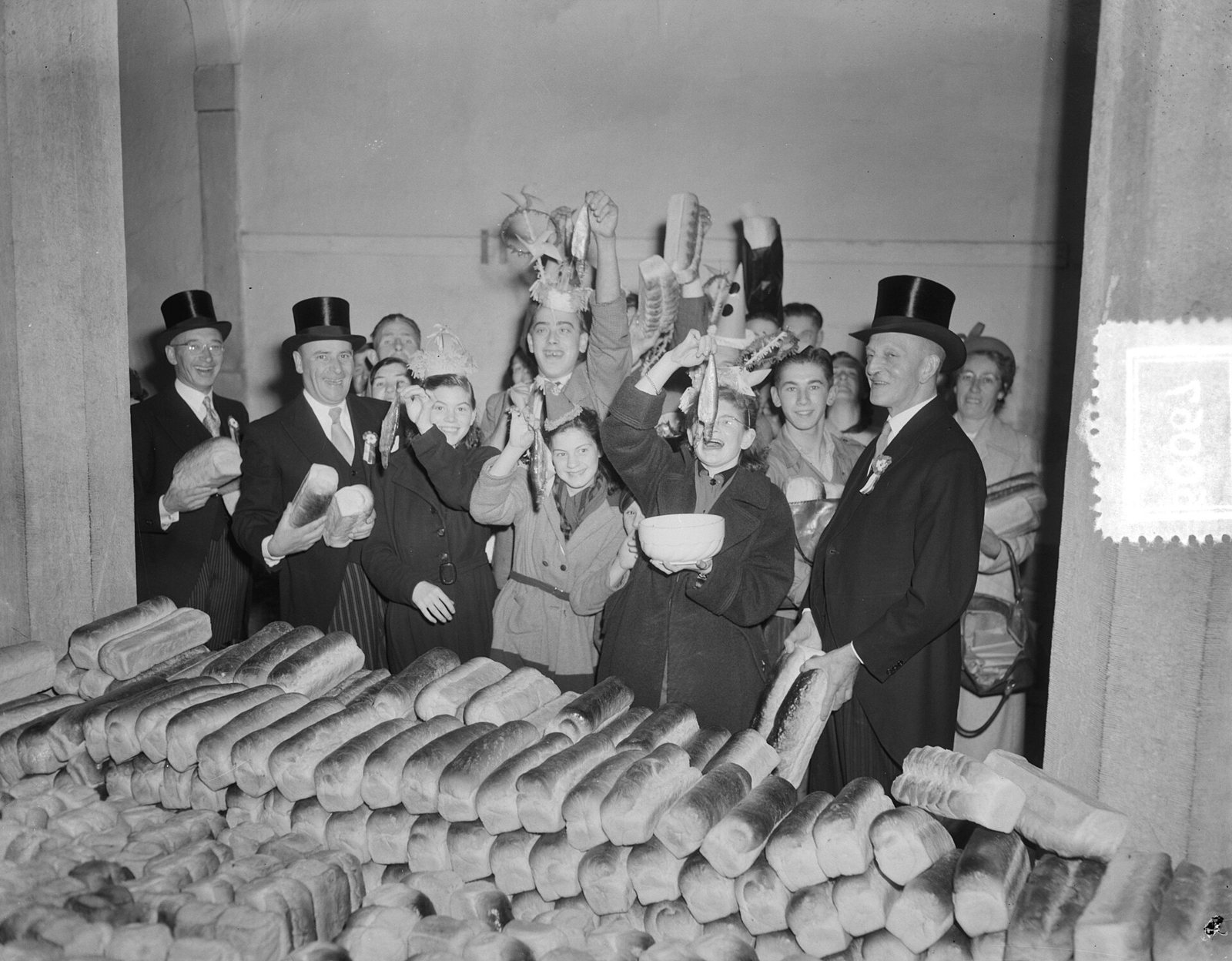 Herring and white bread
The rest of the year, Leiden is a quieter place. It is a compact city inside a ring of moats called the singels, gabled brick houses standing shoulder to shoulder over the canals, houseboats on the quays, the whole centre crossable on foot in about twenty-five minutes — though nobody manages it, because a bridge keeps opening a view along another canal. A good share of the city is students, tens of thousands of them; the bicycle garage under the station forecourt holds thousands of bikes, with a lit display at the door counting the empty spaces like a car park. Getting here is part of the ease: the right train from Schiphol is a plain Intercity or Sprinter with Leiden Centraal on its list of stops, about a quarter of an hour — the fast trains signed for Rotterdam share the platforms and skip Leiden entirely. Tap the same card or phone in and out; mixing them charges the maximum fare. Cars are mostly kept out of the centre by design, and the red lanes belong to bicycles. You see a Dutch city from its bridges and its boats, and through doorways that turn out to lead somewhere.
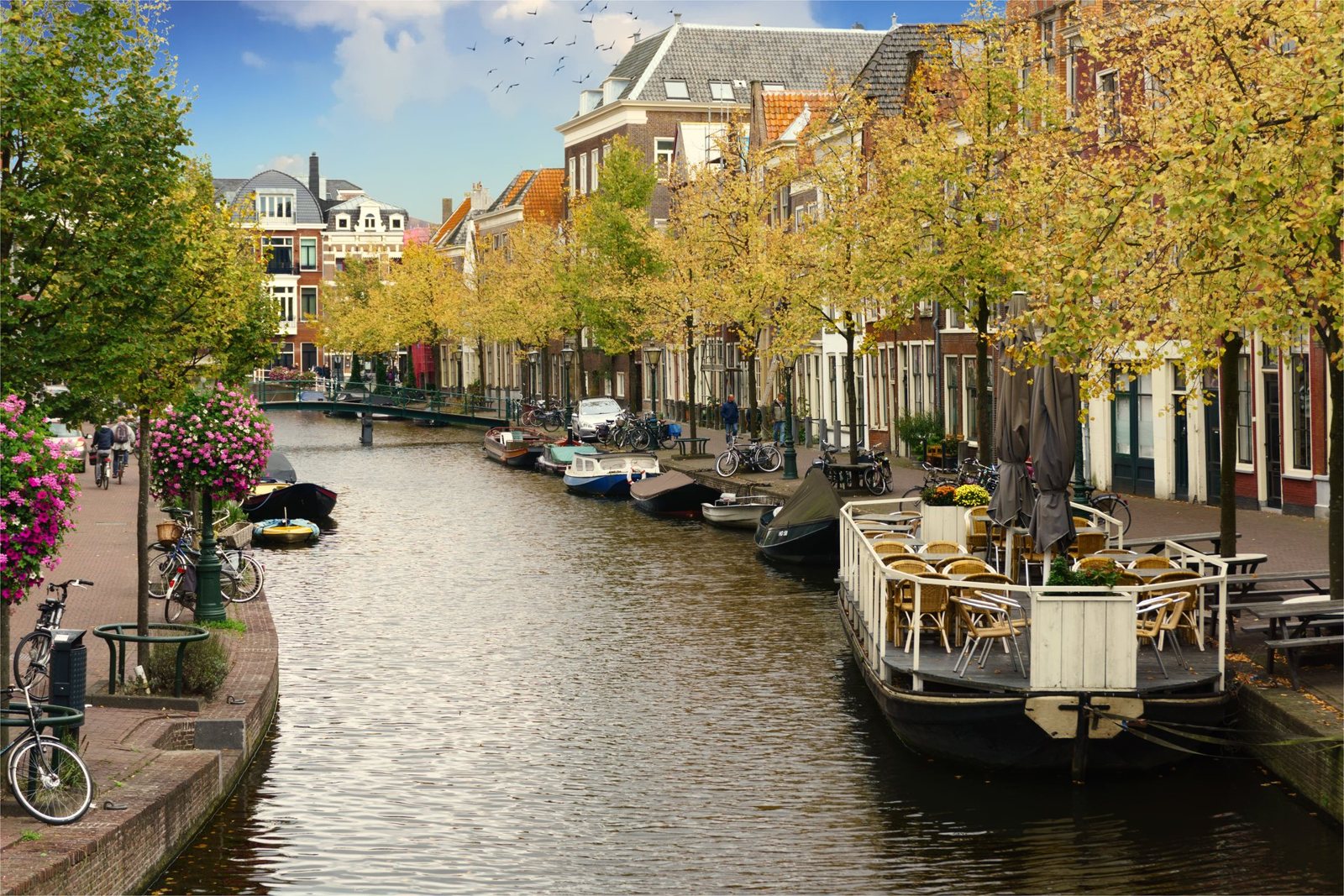 A Leiden canal in autumn
On Wednesday and Saturday the canal turns into a market. From eight in the morning until five, stalls run along both quays of the Nieuwe Rijn and over the Botermarkt, the Vismarkt and the Aalmarkt — vegetables, fish, flowers, cheese, stroopwafels pressed fresh between hot irons, poffertjes eaten standing up from a paper tray. People in Leiden do their weekly shopping here; visitors get to join them. A traveler who stops in the middle of the quay to film will quickly learn how a Dutch bicycle bell sounds at close range. Step onto a bridge and watch from above.
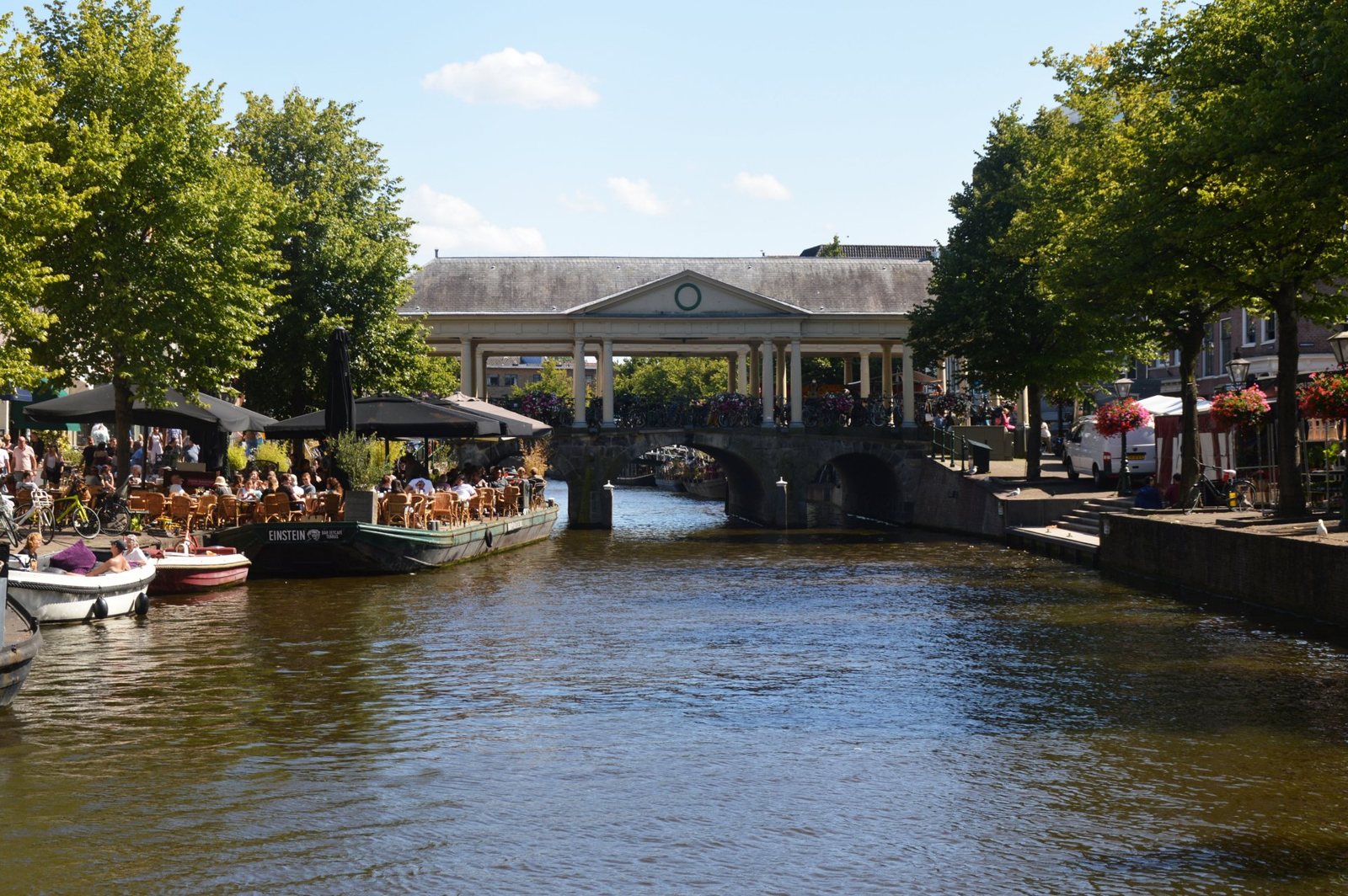 The Nieuwe Rijn
The herring comes first. At the corner of the Nieuwe Rijn and the Karnemelksbrug — the Buttermilk Bridge, a fitting name in a dairy town — Vishandel Atlantic runs its market stall every Wednesday and Saturday, and in 2012 and again in 2013 the AD newspaper's national Herring Test ranked Atlantic's herring first in the country. It comes the Dutch way, with chopped raw onion: the fish held by the tail, the head back, down in a few bites. Ask for a fork if you prefer, but give the herring a try. Then the cheese, because Leiden has one of its own and protects it in law. Look for a dark, red-brown rind with two crossed keys pressed into it, from the city's coat of arms: Boeren-Leidse met sleutels, farmhouse Leiden cheese with keys, European protected-origin status since 1997, made only by members of the farmhouse cheesemakers' association. It began as what was left after butter-making — the cream went to the churn, and the skimmed milk, with cumin seed worked into the curd, became a lean cheese that kept, lean enough, it is generally held, to sail east as ship's stores for the Dutch East India Company. Supermarket Leidse without the keys is a different, ordinary cheese. Here the keys are what to look for.
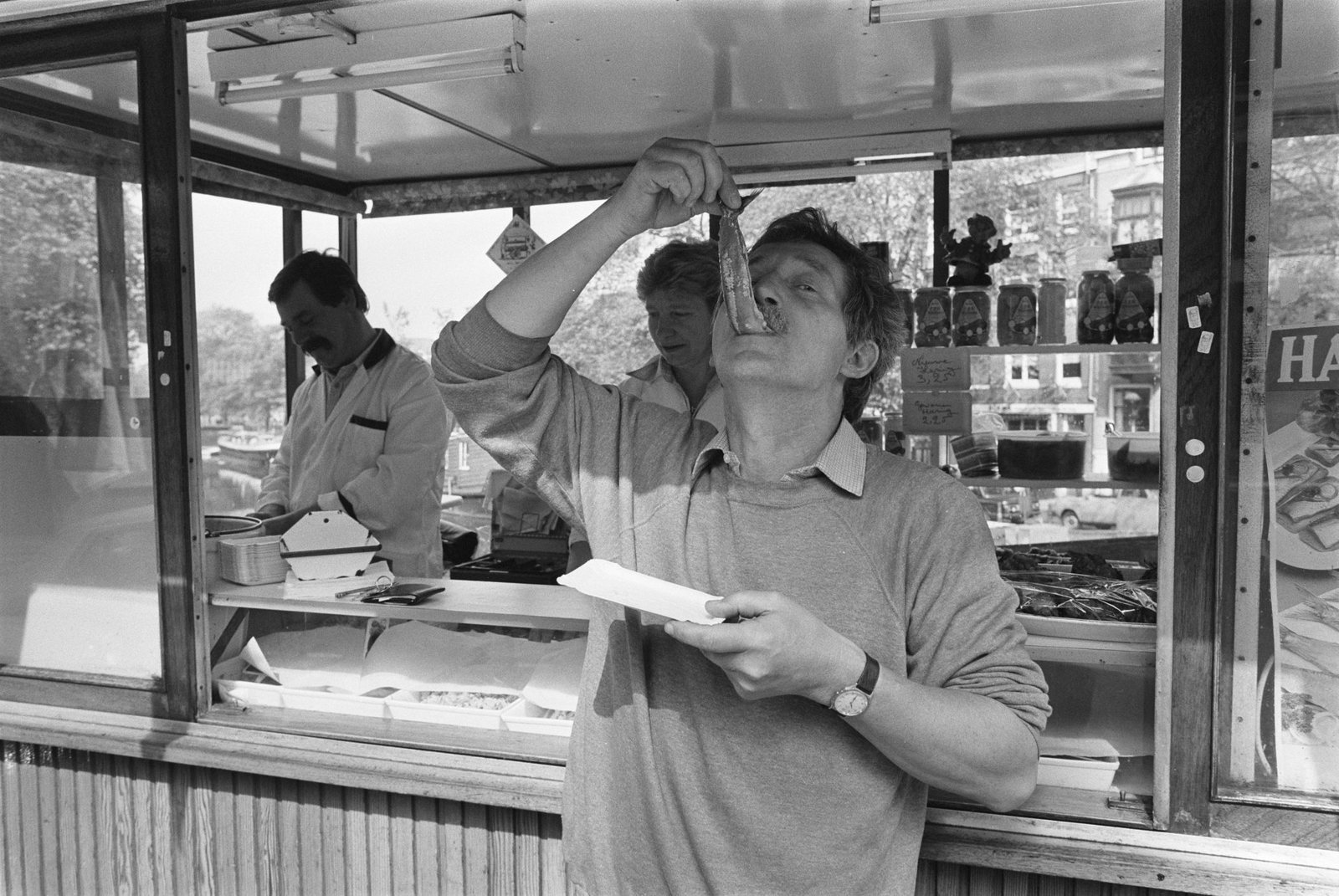 Eating a Hollandse Nieuwe
By the time the stalls are packed away, the traveler needs a room, and in Leiden the room is part of the trip. The city's historic hotels all charge the same price: stairs. The old houses were built for merchants who carried goods up to the attic on a hoist; they were not built for wheeled suitcases, and the people who restored them have mostly declined to pretend otherwise.
For the oldest building on this list, look to the Steenschuur, the broad water that runs on from the Rapenburg. Steenhof Suites occupies two adjoining canal houses, one a national monument, its front-house roof timbers tree-ring dated to the 1460s, its stepped brick gable still in its original deep red; the house survived the 1807 explosion of a gunpowder barge on this same canal. The Royal Suite has a fireplace more than five hundred years old and windows over the water, and a late-medieval cellar below holds wine tastings. The limitations are the old oak staircase, steep and narrow, and a house rule that takes no children under four. For a couple who want to sleep under timbers cut before Columbus sailed, this is the room.
A different traveler wants the water right outside the front door: Boutique Hotel Huys van Leyden, on the Oude Singel, is a restored canal monument the hotel dates to 1611, a handful of rooms, breakfast in a baroque first-floor room, and its own sloop moored in front — a guest can go from breakfast to the water without crossing a street, and that is much of the hotel's appeal. No lift, and the canal view comes only with specific rooms, so choose deliberately.
Three more earn a place on the list: Boutique Hotel d'Oude Morsch, in the 1817 guardhouse of a town gate, no lift, no air-conditioning; beside the station, the Fletcher, a modern tower with a lift and an indoor panorama pool, a convenience choice that does not pretend to be a heritage one; and on the Kloksteeg, a few doors from where the Pilgrims' pastor lived, Boutique Hotel Ex Libris, small, listed, and up original stairs the hotel itself calls quite steep.
The quickest way to fix the map in one's head is to climb Leiden's one hill. Push through a wrought-iron gate dated 1653 at the end of the Burgsteeg and walk up the Burcht, an artificial mound raised in stages around a thousand years ago where the Oude Rijn and the Nieuwe Rijn meet; the counts of Holland made it a stronghold, and the round ring wall that crowns it went up in the twelfth century. There is nothing left to defend and nothing to pay. Walk the parapet all the way round: a field of red roof tiles, the Hooglandse Kerk just underneath, the Pieterskerk further off. Climb it on the first afternoon and the streets will start to match the map. The canals look different again from the water — fifty minutes under the bridges in an electric boat from the Blauwpoortsbrug, covers and heating in bad weather, or a rented sloop with no licence needed. The bridges are low, and any renter who takes the wheel after a long lunch and misjudges an arch should know that the bridge was there first. Afterwards, the brown cafés: De Bonte Koe, below the Burcht, keeps an interior unchanged for more than a century, its walls covered in tile pictures of country scenes; on the Schoolsteeg, the Van Goyen Jeneverhuis pours more than eighty jenevers in the house where the painter was born, a café since 1809. Order a jenever with a plate of bitterballen, and at De Bruine Boon near the station, the apple pie is baked in-house every morning — a good choice with coffee.
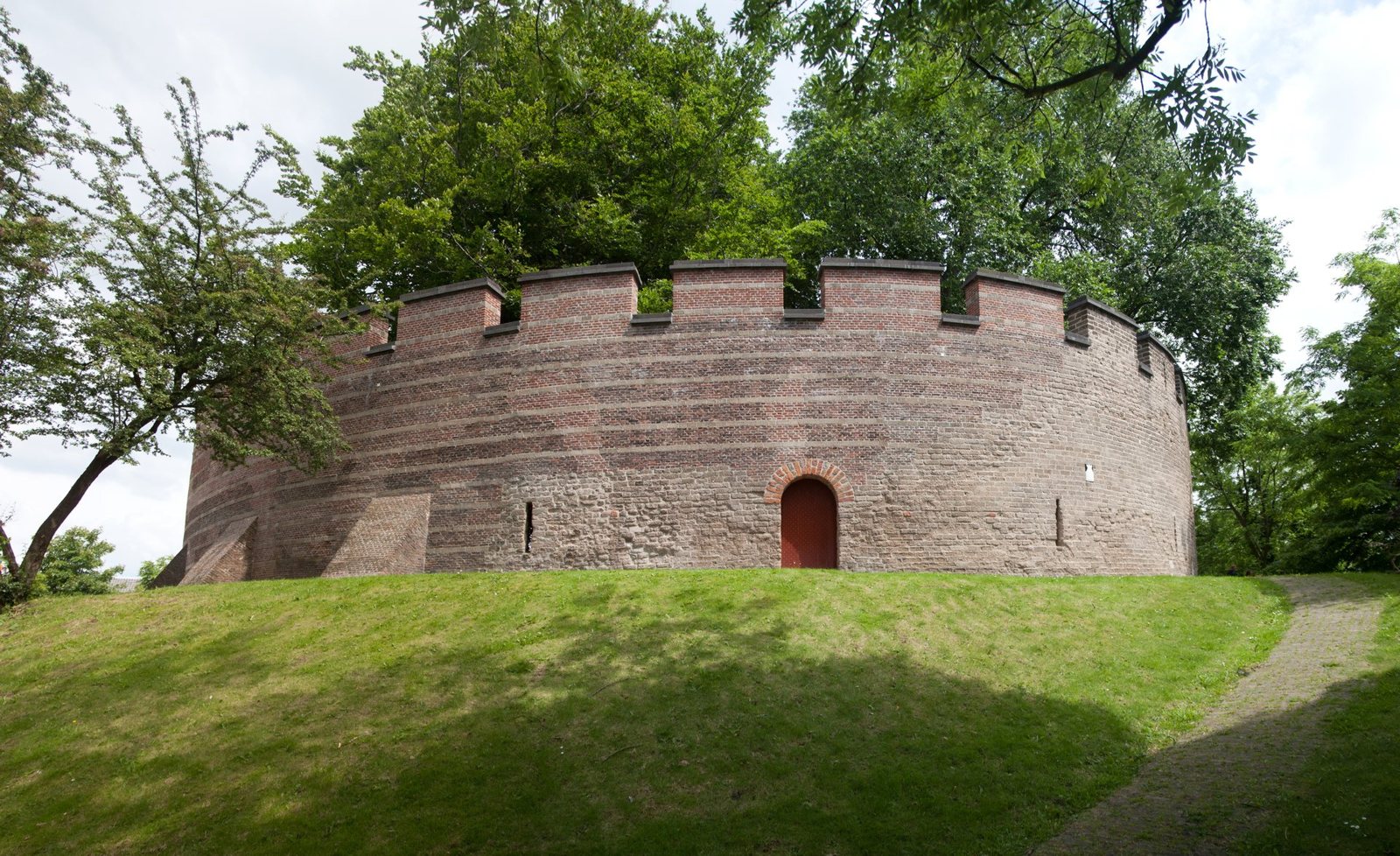 The Burcht ring wall
The Rapenburg is the canal Leiden would put on its postcard, and the university made it that way. The city tells a story about how it got the first university in the Netherlands, and every Leidener tells it well: after the siege, William of Orange offered the citizens a reward for holding out — a few years free of taxes, or a university. They chose the university. It was inaugurated in the Pieterskerk on 8 February 1575. The university's own historian cautions that the reward story is not certain. The city still tells it that way. Under the arch beside the Academiegebouw is the Hortus botanicus, founded in 1590, the oldest botanical garden in the Netherlands; give it two hours, and expect glasses to fog in the tropical greenhouses coming in from a Dutch November. In 1593 the botanist Carolus Clusius arrived to run it, bringing tulips he had collected in Vienna through contacts with the Ottoman world. Clusius was not the first person to bring a tulip into the Netherlands, but the first tulip collections in the country grew in this garden, so successfully that a print from 1610 shows a fence put up to keep thieves out of the beds; the great bulb fields of the coast trace their line back to these beds. Across the canal, the Rijksmuseum van Oudheden fills its central hall with the Temple of Taffeh, a limestone temple from the reign of Augustus, given by Egypt in thanks for the Dutch part in saving the Nubian monuments — visitors can walk right into it — and it is open on Mondays, which matters in a country where many museums close that day. Look up while walking anywhere along here: Leiden paints poetry on its walls, in the poets' own languages — Tsvetaeva in Russian, Shakespeare's thirtieth sonnet, a haiku by Bashō. It works best unplanned, because the poems turn up anyway.
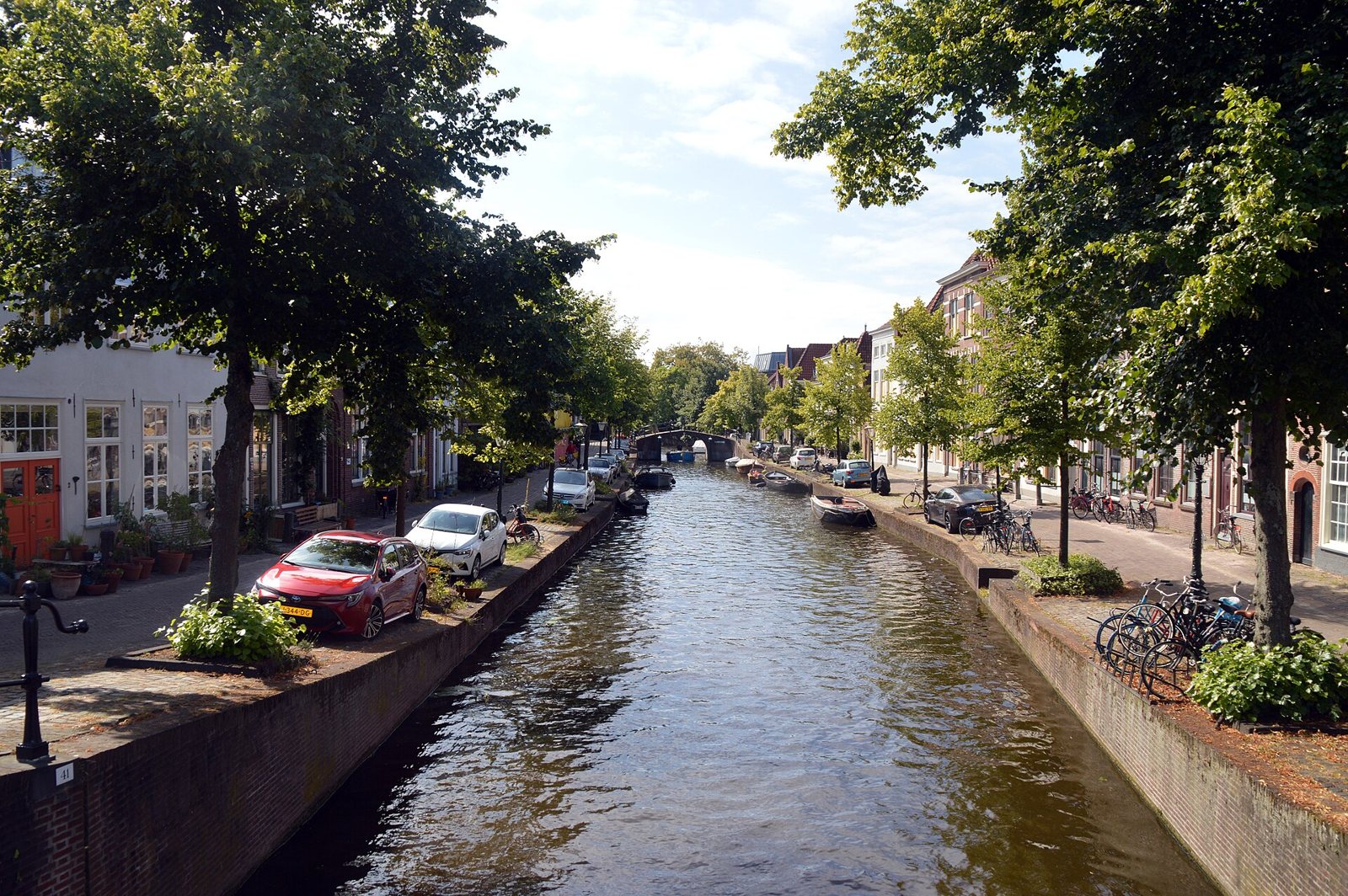 The Rapenburg canal
Some of Leiden's quietest places are hidden behind ordinary doors. There are dozens of hofjes in the city: almshouse courtyards, a square of small houses around a lawn, behind a plain door on an ordinary street. Almost all can be visited, many are still lived in, and the main rule is quiet — a hofje is a street of private homes, not a monument with a gate. The Sint Anna Aalmoeshuis on the Middelstegracht opens its door every day. Look around quietly, and leave.
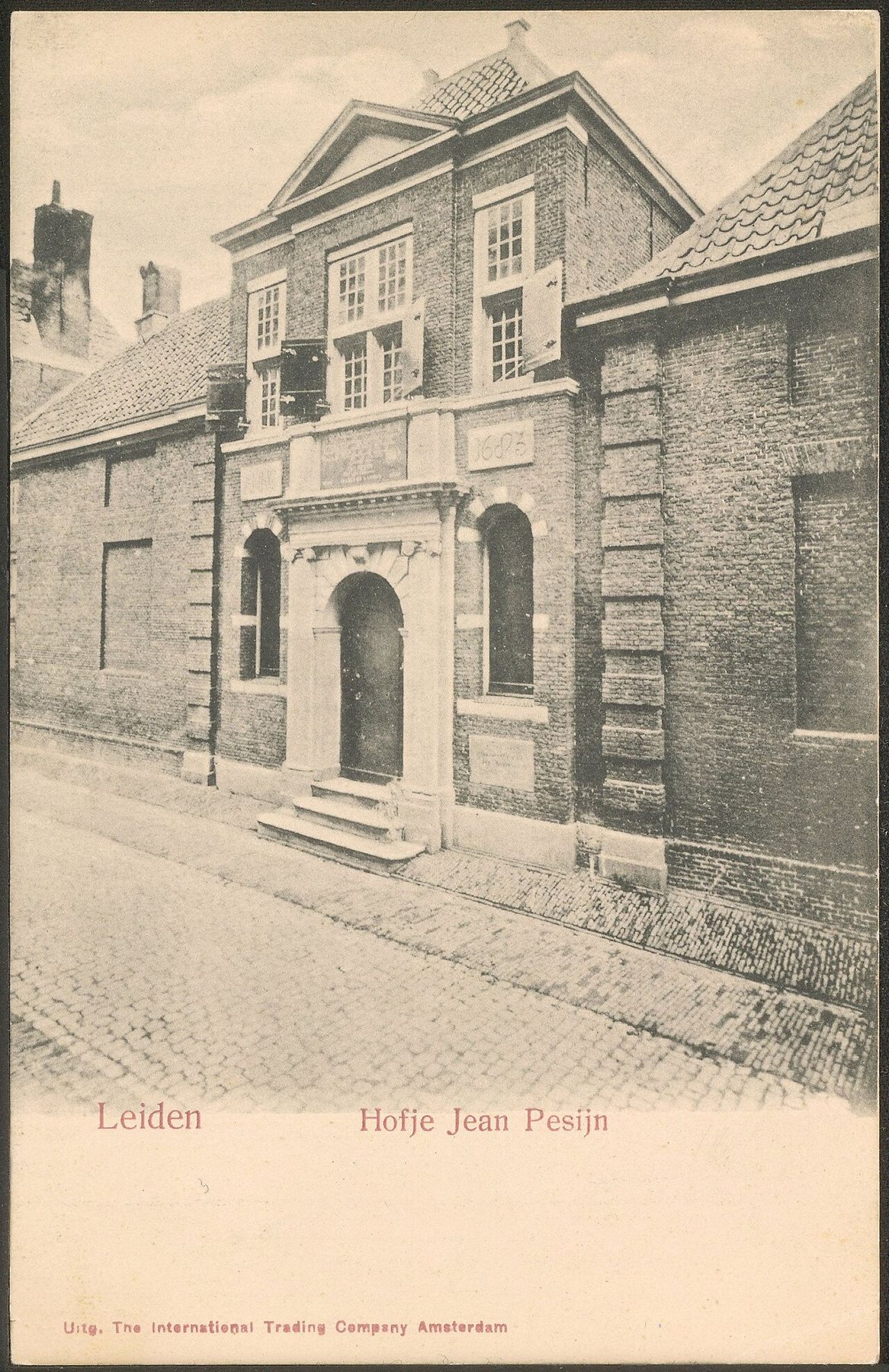 The Jean Pesijn Hofje
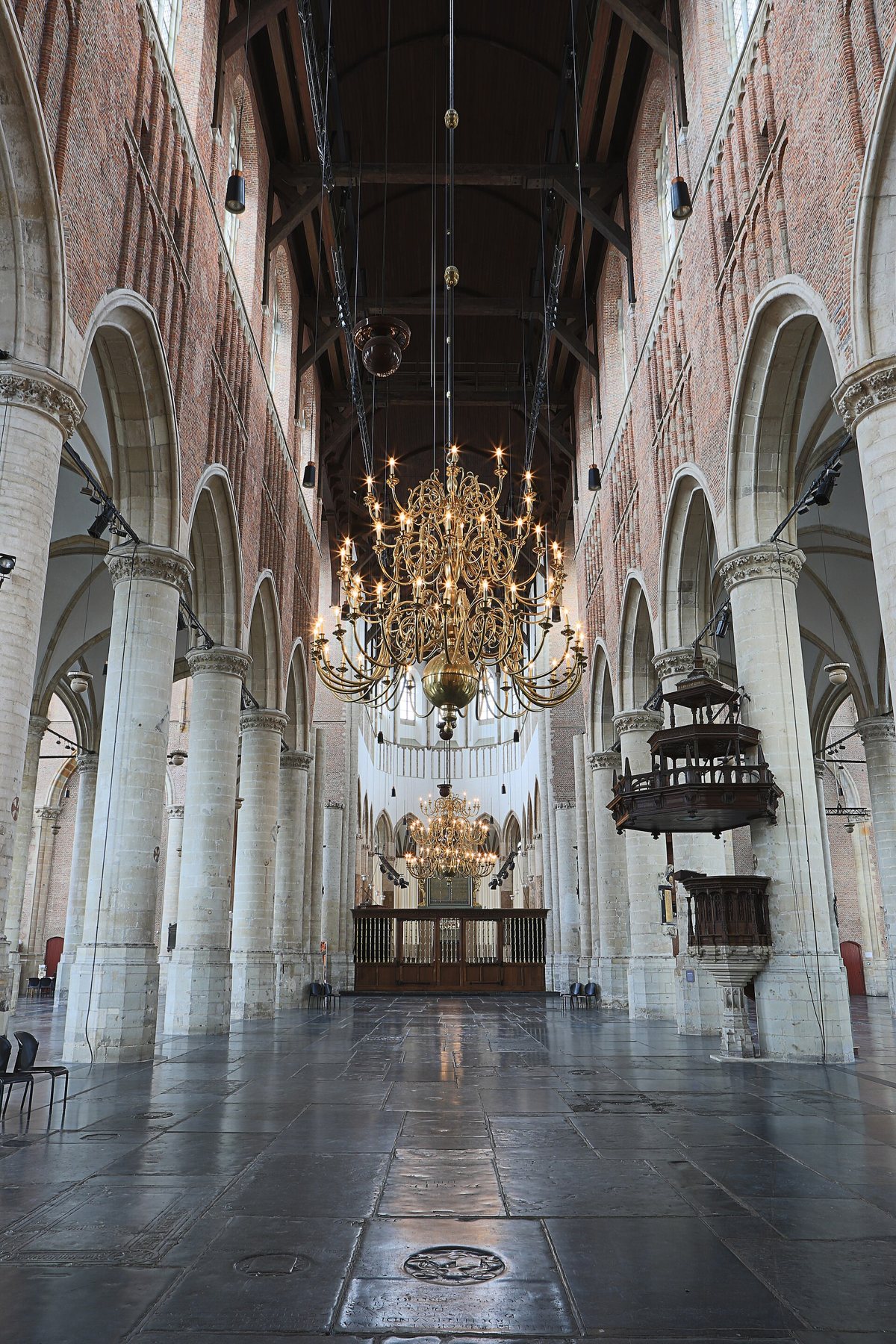
One of those doors opens onto the Pilgrim story. The Pieterskerk is the great Gothic hulk the old town wraps around: a chapel consecrated on the site in 1121, the standing church built from about 1390, its tower collapsed in 1512 and never rebuilt. It is no longer a parish church; its floors are a field of memorial stones, and Rembrandt's parents are buried here. Guidebooks have long said Rembrandt himself was baptised in this church, but no record of it survives. In 1609 a congregation of English Separatists, farmers and craftsmen mostly from around Scrooby in Nottinghamshire, moved here from Amsterdam with the city council's written permission. They worked as weavers, printers, tobacco sellers and hatters. Their governor-to-be, William Bradford, wrote that they had chosen "a fair & bewtifull citie, and of a sweete situation, but made more famous by the universitie" — and he was just as plain about the cost of living there: "hard and continuall labor." In 1611 their pastor, John Robinson, bought a house directly opposite the church on the Kloksteeg and had a row of small houses built behind it. The houses are gone; in their place stands the gate of the Jean Pesijnshofje, an almshouse built in the 1680s, its wall stone reading: "On this spot lived, taught and died John Robinson, 1611–1625." The courtyard's own historians insist on one point: the Pilgrims never lived in this hofje. Around the corner, a lane once called the Stinksteeg now carries the name of William Brewster, the congregation's elder, who ran a printing press there, turning out tracts against the bishops of King James that were smuggled into England. When the congregation decided to sail for America, Robinson stayed behind with most of his flock, intending to follow; he died in 1625 and is buried somewhere under the floor of the Pieterskerk — nobody knows where, because the church's graves have been cleared more than once.
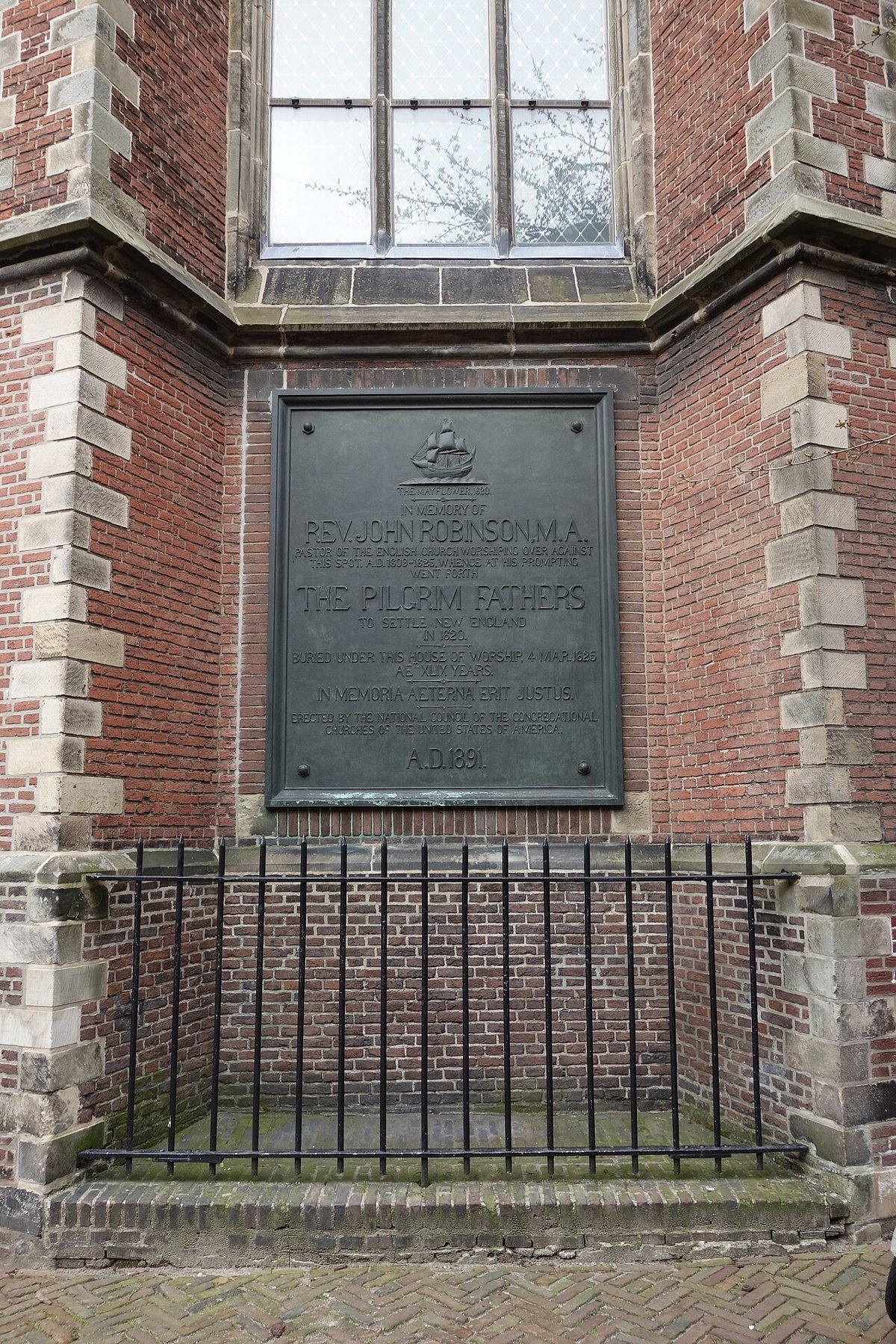 The Robinson memorial plaque
The Pilgrim Museum, founded by the American historian Jeremy Bangs, who died in 2023, moved in 2025 into the church's former sexton's house next door, entered through Museumcafé Pieter on the Kloksteeg. Inside is a reconstructed room of the Pilgrims' Leiden years. It opens in the afternoons, and it does not hold Edward Winslow's portrait: that painting, the only portrait of a Pilgrim made from life, hangs at Pilgrim Hall Museum in Plymouth, Massachusetts. The museum's curator, Sarah Moine, makes a larger claim: that the American Thanksgiving took its shape from what the Pilgrims saw here every October — a city-wide day of thanks for deliverance, with a church service and a shared meal. Other historians dispute her interpretation. What nobody argues about is the order of events. (The siege and the feast it made are told below.) Leiden was holding its feast of thanks long before Plymouth held its harvest meal. For Americans in town at the end of November, one more thing: for years the Thanksgiving service organised by Overseas Americans Remember filled the Pieterskerk on the fourth Thursday. In 2026 the costs of the church became too much, and the service moved to the theatre of the American School of The Hague, in Wassenaar. On that Thursday the church keeps its ordinary hours and the bicycles go past as usual, and the traveler who came looking for the start of an American holiday finds a Dutch city getting on with its day. Across the lane is the place to eat afterwards: Het Prentenkabinet, in a building the restaurant traces back to 1268, the neighbourhood's special-occasion table — in November, pheasant rolled in serrano ham and green herbs, served with hete bliksem, "hot lightning," the old Dutch mash of potato and apple.
The wealth behind those gables came from cloth, and the building where it was inspected is now a museum of Leiden's history. For seven centuries Leiden wove wool, and at its height, by De Lakenhal's own account, it was the most important textile centre in the world. Every bolt had to pass inspection in the Laecken-Halle of 1641 on the Oude Singel, which is where the museum is today. The museum does not hide where the money came from: children worked in the trade, and Leiden cloth was used as currency in the slave trade. Inside are the Rembrandts — a handful of his paintings from the early Leiden years, among them The Spectacle Seller, from about 1624, the earliest work of his that is known, painted when he was about eighteen; anyone standing in front of it may find themselves thinking about what they had done by eighteen. And in the Lakenhal is the pot. It is bronze, with a poem engraved on its belly. The Spanish left it full of stew in their abandoned redoubt at Lammenschans on the morning the siege broke. To understand why Leiden treats that pot as a relic, the visitor needs the third of October.
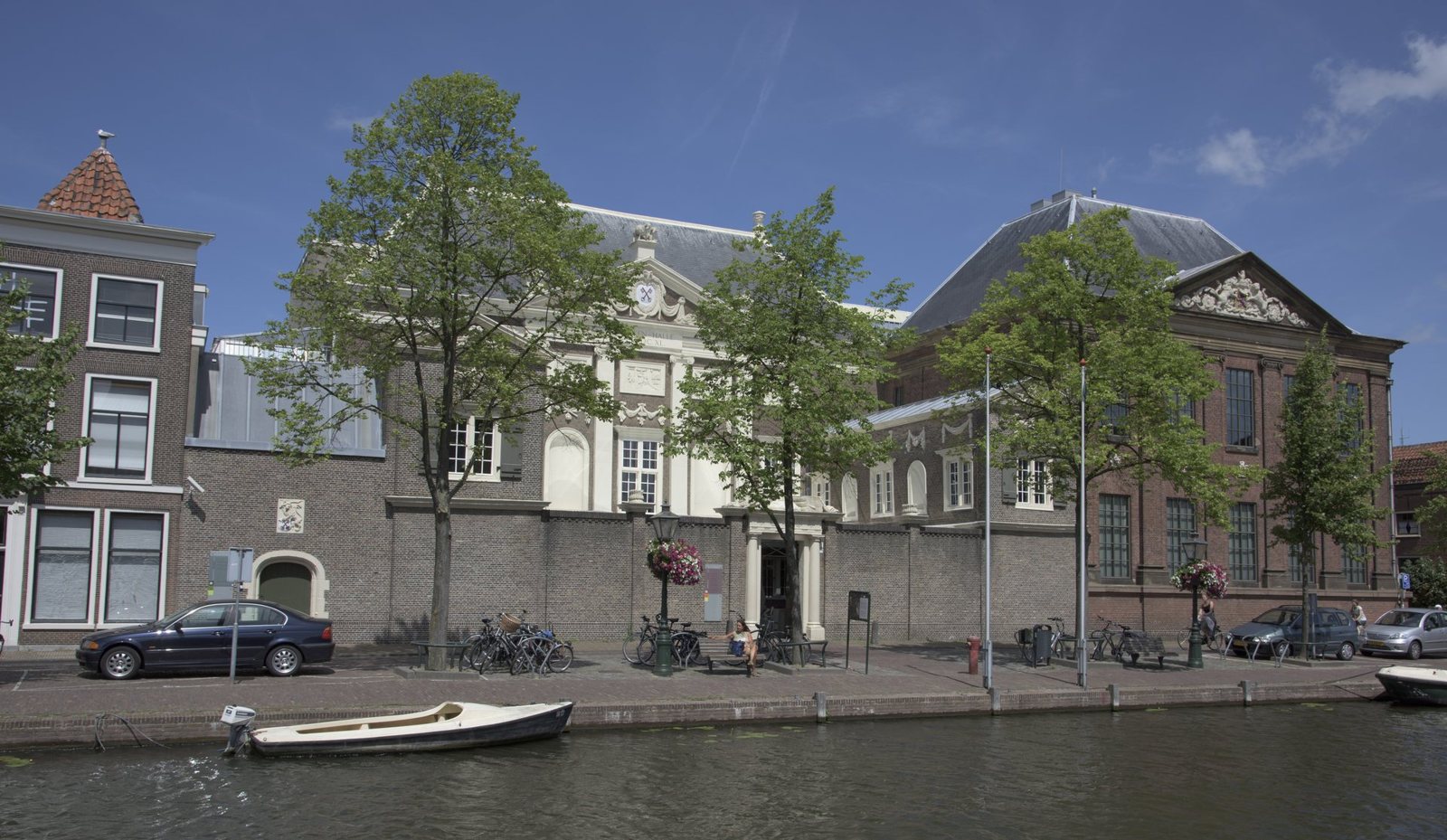 Museum De Lakenhal
In 1573 and 1574 the Spanish army besieged Leiden to starve it into surrender. There was not enough beer, so people drank canal water, and plague followed the famine. Tradition tells of the mayor, Pieter van der Werff, offering his own body as food to the starving crowd; a park in the city carries his name. The relief came by water. William of Orange's forces cut the dykes, the polders flooded, and on the night of the second and third of October 1574 the Spanish withdrew. At dawn the relief fleet sailed in over drowned fields — and the herring and bread were brought, handed out to a city that had earned them. The pot was found. The museum names the first man into the empty Spanish fort as Gijsbert Cornelisz. Schaeck, a Leiden privateer, who carried it home. Over the centuries the city replaced him in its memory with an orphan boy, and the museum calls that version incorrect and wildly popular. A statue of the orphan stands at Lammenschans anyway. What was in the pot is also disputed, but one thing is agreed: there were no potatoes, because the potato barely fed anyone in the Low Countries in 1574. Today's hutspot is a mash of potato, carrot and onion served with slow-cooked beef; the 1574 pot held something closer to a stew. Whether it held parsnips, as older accounts insist, is doubted by Jacques Meerman, the food historian who wrote the book on hutspot. The day itself still runs on the city's own clock: the evening before, the great hutspot meal on the Hooglandse Kerkgracht and the Taptoe procession of lights; on the third, reveille at seven, the Waag handing out its herring and bread, chorales in the Van der Werfpark, the commemoration service at ten — the oldest part of the day — the great parade at one, fireworks at half past eleven. Leiden restaurants put hutspot on the menu for the second and third of October, and nobody has crowned a best one: the choice is the date, not the restaurant. The rest of the year it is a dish cooked at home. And a traveler who books Leiden for that date to see the museums should know the Hortus, the windmill museum and several others close on the third — the city has other plans.
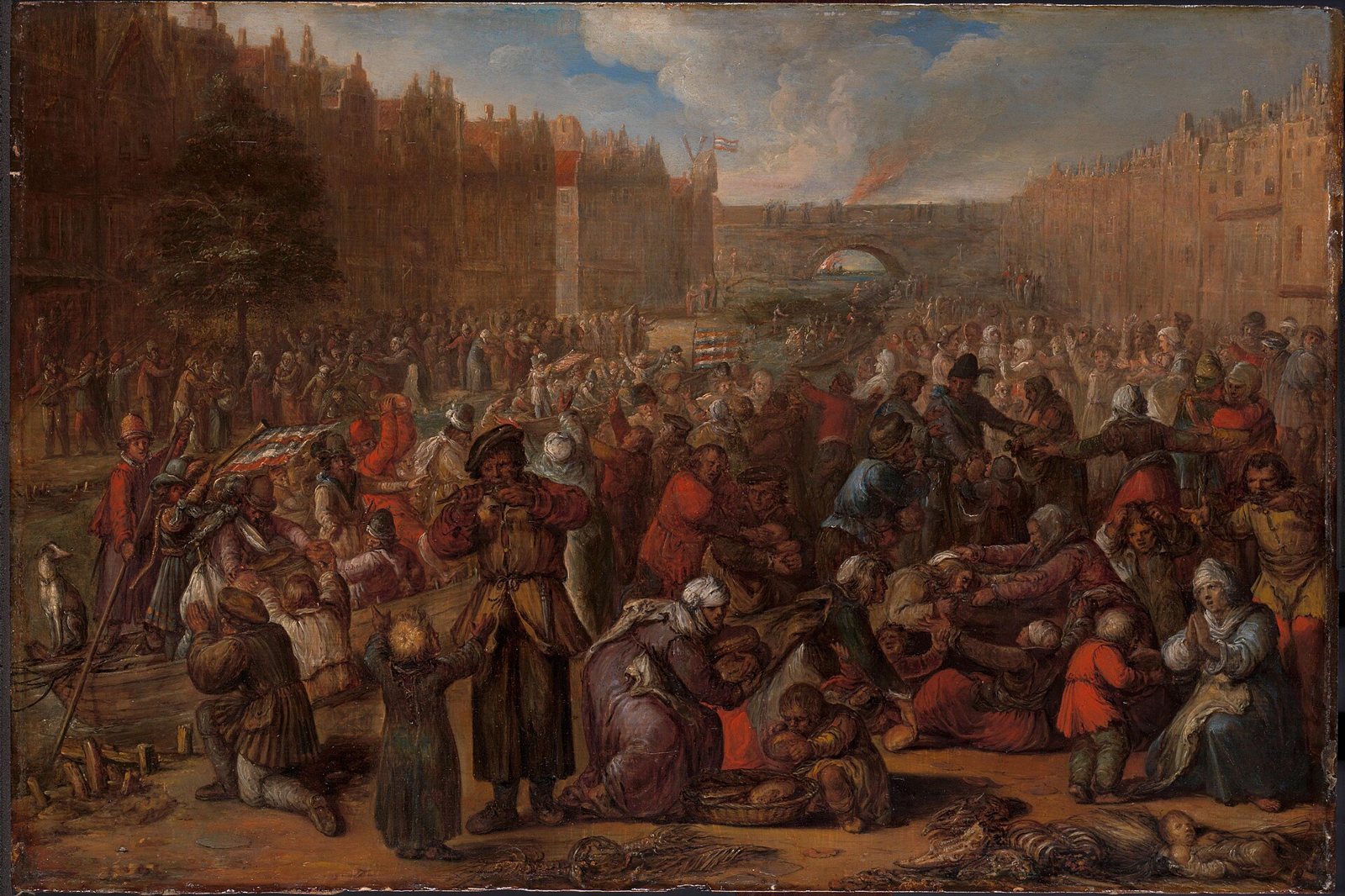 The relief of Leiden
The rest of the year, Leiden eats in a way that reflects where its ships went and who came back on them. The rijsttafel was born in the colonial Dutch East Indies: a table of many dishes set around rice. Leiden's university trained the civil servants who ran the Indies, and Indonesian students came the other way to study here; after 1945, families repatriated from the Indies cooked it in boarding-house rooms, in secret, on oil burners, over landladies' complaints about the smell. The Indies rijsttafel is now listed on the Dutch national inventory of intangible heritage. The rijsttafel's history is inseparable from Dutch colonial rule. The full table is at Surakarta, on the Noordeinde: the kitchen traces itself to Central Java, where cooking is less fiery and a little sweeter, so three house-made sambals come to the table for diners to add heat to taste. The dish to order carries the house's name — the Rijsttafel Surakarta, for two, which reviewers say will feed three; the room is tight and a booking is needed most nights. A few streets away, Bistro Bar Matur cooks modern Indonesian dishes as shared plates — during Ontzet one October it served hutspot with rendang, which may be the most Leiden combination anyone has cooked. Near the station, Café Visscher holds a Michelin Bib Gourmand, and the guide names the dish itself: the pointed cabbage, treated as a main course in its own right. That is the must-order. The splurge is In den Doofpot on the Turfmarkt, the city's highest Gault&Millau score, where Michelin's guide praises precise reinterpretations of classic Leiden dishes — let the kitchen choose. And Oudt Leyden, on the Steenstraat, has served pancakes since 1907 on enormous Delft-blue plates; the classic savoury order is bacon, cheese, mushrooms and onion, and booking is strongly advised. Before leaving town, buy a sleutelkoek, the butter biscuit printed with the city's crossed keys, from the Jacobs patisserie on the Nieuwe Rijn. It is the souvenir that fits in a pocket.
Just beyond the singels, the flat countryside is easy to reach. Molen De Valk, built in 1743, stands five minutes from the station on what was once the town wall, the only survivor of the windmills that once stood on Leiden's walls; it grinds grain again, and its stairs are steep enough that the museum warns it cannot take wheelchairs. Rent a bicycle and ride west: the North Sea at Katwijk is close on a fast cycle path, and the frequent buses from the station square reach the beach front in about half an hour. In November the coast is for walking, not swimming, and the brown café is waiting back in town. In spring, cycle north to Keukenhof at Lisse, open from mid-March to early May, entry by timed ticket, the non-stop bus from Leiden Centraal about half an hour — worth a return trip on its own, through fields that belong to the growers; the one rule of the bulb country is to stay out of the crops. The Hague is about eleven minutes by Intercity, the Mauritshuis a ten-minute walk from its station, with Vermeer's Girl with a Pearl Earring inside; Delft, well under half an hour south, still makes its blue the old way, by hand, at Royal Delft; Haarlem, a short ride north, hangs Hals and Rembrandt side by side at the Frans Hals Museum this winter — Rembrandt in his birthplace and in Haarlem in one day, if the traveler is quick. Kinderdijk is the long haul, never a short trip: well over an hour each way with changes, for its windmills standing in a row over a polder — worth it for the sky, with the day planned around it.
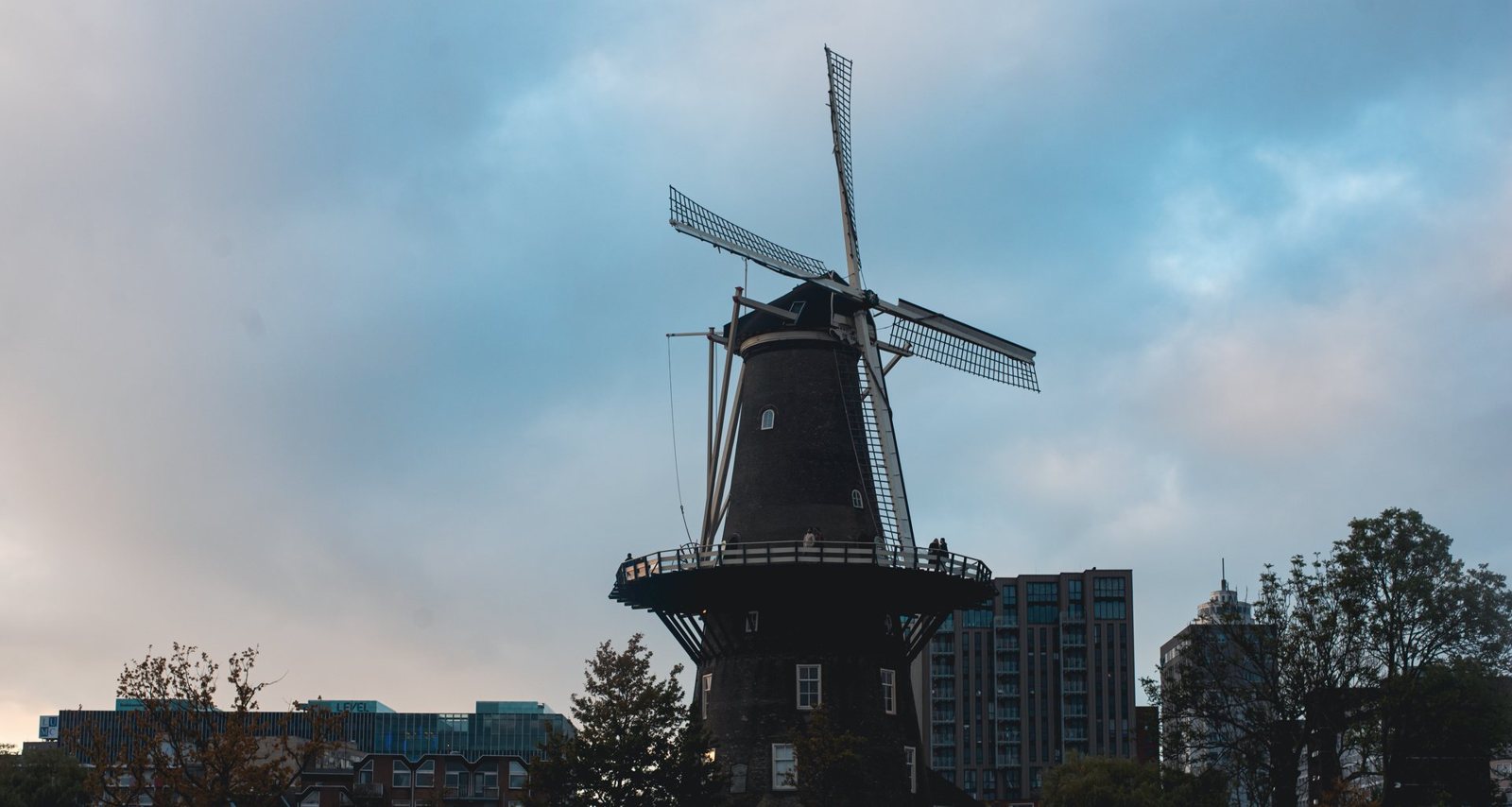 Molen De Valk
The trip ends where the Pilgrims' did, on the water, at the edge of the old town. In July 1620 the travelers took boats south from Leiden, by way of the Vliet and Delft, to Delfshaven. "So they lefte that goodly & pleasante citie," Bradford wrote, "which had been ther resting place near 12. years; but they knew they were pilgrimes." At the quay, he recorded, even the Dutch onlookers wept, until the tide, "which stays for no man," took them. The city they passed through had been there for centuries and carried on for centuries after them. It held out against a siege and gave thanks for it. It took in English refugees, let them print what their own king had banned, and taught anyone who could manage Latin. When they left, it let them go with tears on the quay, and then it went back to work: weaving, milling, teaching, painting, and later serving a rijsttafel for two in the old student quarter. The Pilgrims spent more than a decade in a city that had already been holding a day of thanks for decades. Leiden's day of thanks began in 1574, and it has been kept ever since. The herring is handed out in the dark, the bread comes from the baker's ovens, and the pot is in a glass case on the Oude Singel. The traveler who stood in the queue, tasted the keyed cheese, and climbed the mound to see the whole red roofline at once will understand what Bradford meant. It was a goodly and pleasant city. It still is, and it does not need anyone's holiday to prove it.