

Ambergris Caye, Belize : Where the Reef Is the View
A working island town beside the Belize Barrier Reef, where the golf cart is the family car, the best swimming faces the sunset, and a week is the right unit of time.
Here is the sentence that explains Ambergris Caye, and it is the sentence most travel coverage gets wrong: the reef is the view — not the shore.
The Belize Barrier Reef runs about a half-mile off the island's east coast, so the beach in front of most east-side resorts is narrow: seawalls, seagrass beds, and wooden piers reaching over them are the island's signature shoreline. The living coral lies beyond swimming distance; getting out to it is a short boat trip, not a walk from your lounger. And the calmest swimming on the island is on the opposite side entirely — the sheltered west coast, where Secret Beach sits in a lagoon facing the mainland.
Ambergris Caye is not one long swimmable beach, and any guide that promises you one is selling something. What the island promises instead is better: the second-largest barrier reef on Earth, a half-mile out, breaking white against the blue in nearly every view that matters — and a real town wrapped around it. A world-class reef and a town people actually live in: that combination is the whole story here.
San Pedro: a working town
San Pedro, the island's only real town — home to most of its roughly 20,000 residents — is a working place: fishing and tourism shoulder to shoulder, sandy streets, golf carts as the default vehicle of life. It is not a polished resort strip, and that is the point. Travelers who arrive expecting a genuine Caribbean town beside a great reef spend the flight home planning the return.
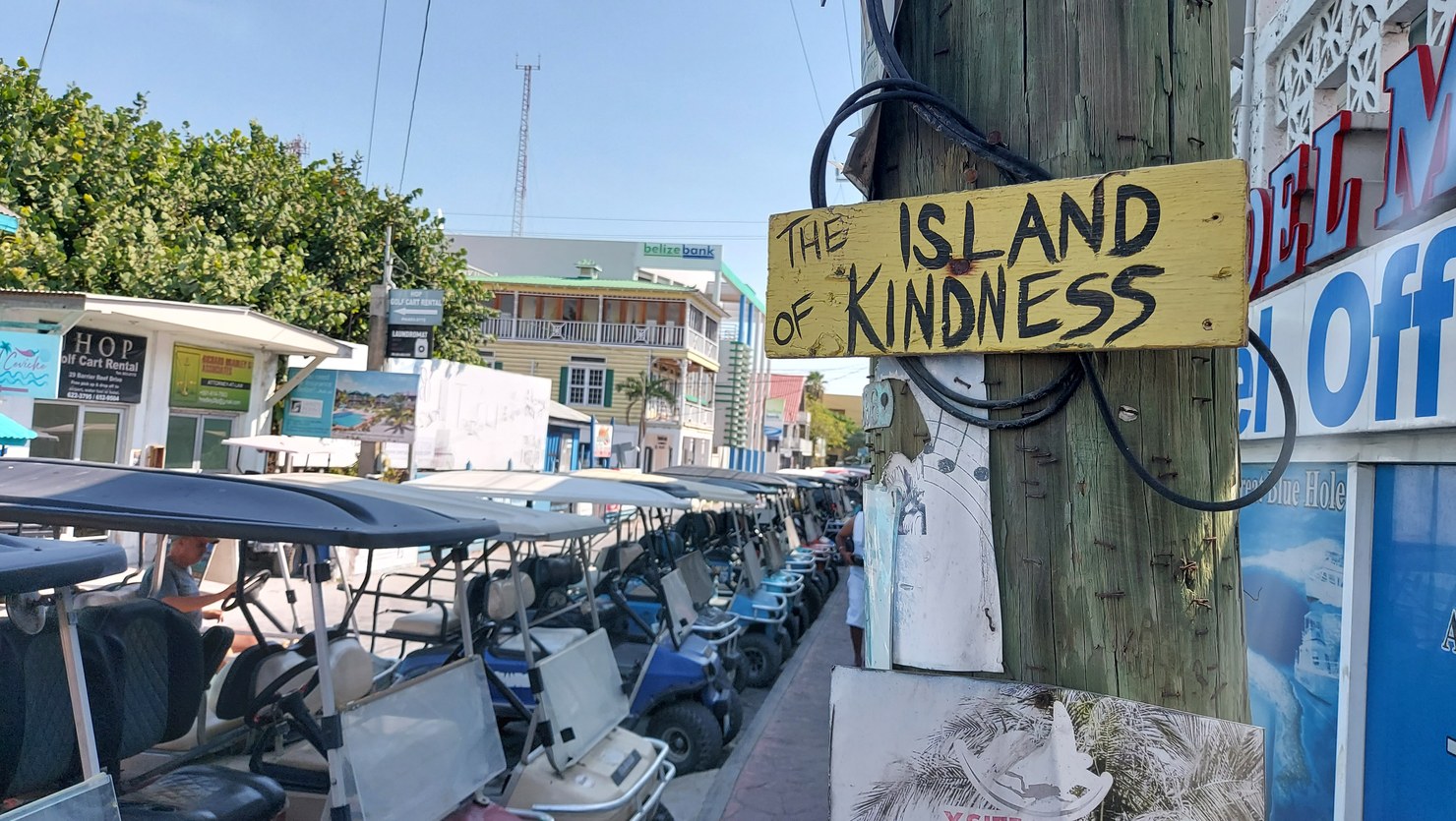 the golf-cart republic
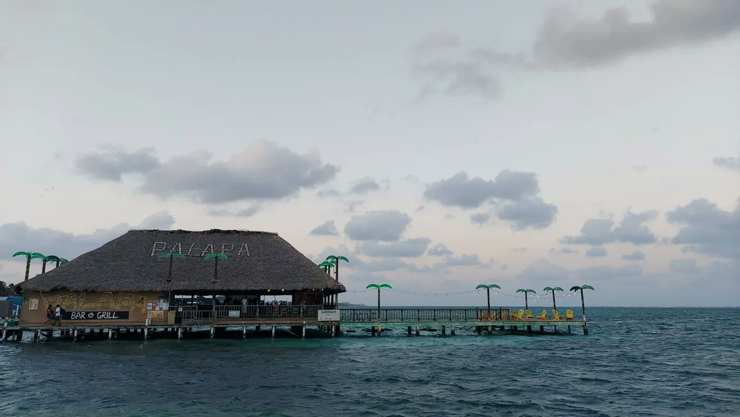 over the water
Getting there: the hop over the reef
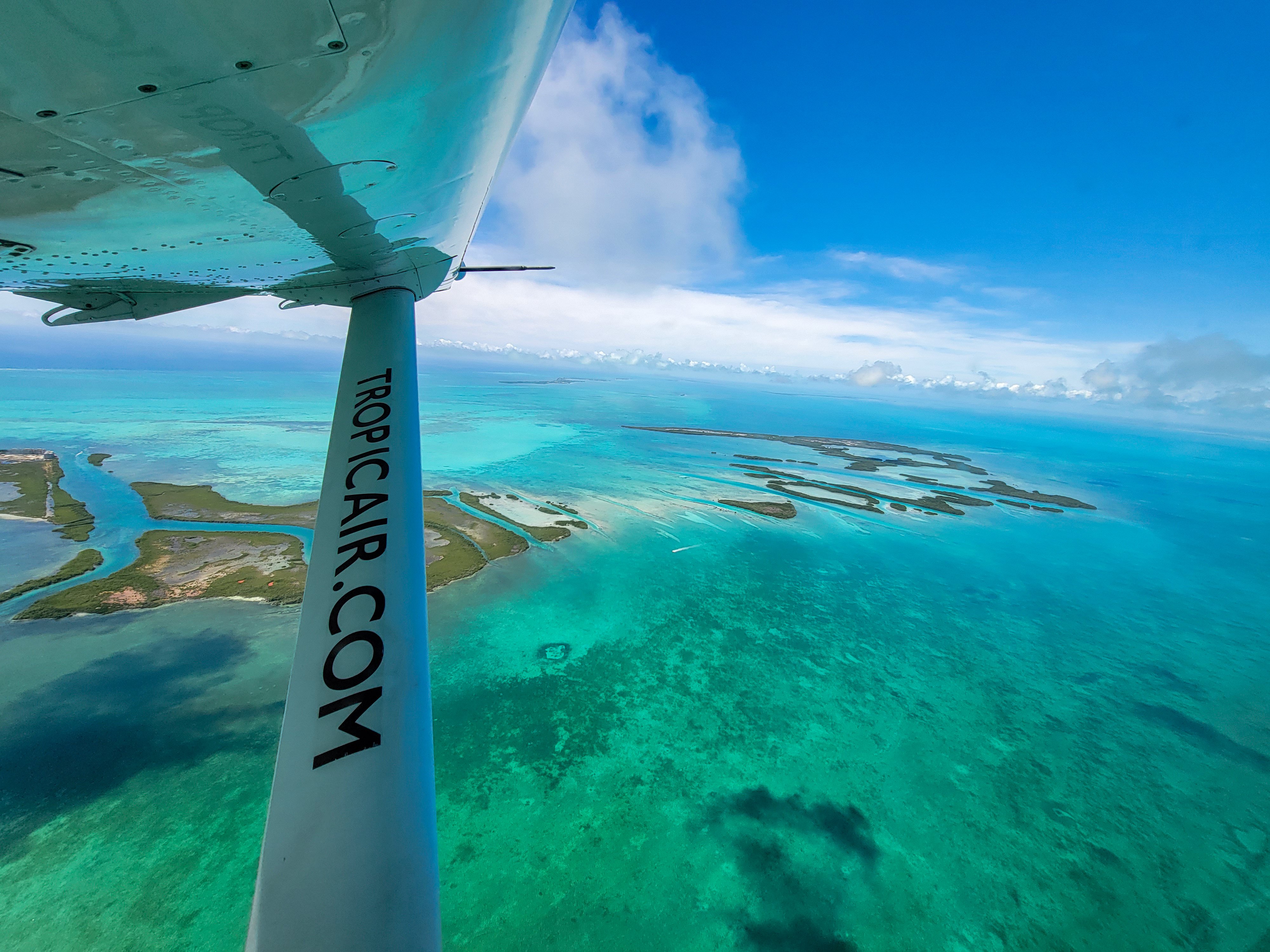
Ambergris Caye is reached through Belize City, then by a short flight over reef water or a boat crossing toward San Pedro. The approach is part of the appeal: the island comes into view before its streets become familiar.
Tropic Air and Maya Island Air fly the hop; San Pedro Belize Express runs the boats. Their sites carry the current routes, schedules, and connection guidance.
The golf-cart republic
Visitors overwhelmingly get around by golf cart, bicycle or on foot. Golf carts are the island's circulatory system — the way to dinner, the dock, and the sunset side. Town itself is compact enough to explore on foot; staying farther out changes the rhythm, with the journey becoming part of an evening.
Where to stay: choose the zone first
Ambergris Caye runs north–south for about twenty-five miles, and where you stay decides your trip. Choose the zone first; the property second.
San Pedro Town is the island's living room — restaurants, dive shops, beach bars, all walkable, no cart required. The beach is reef-front and narrow; the town's charms are social. Start with Ramon's Village, the island's thatched-roof classic, where the reef dock matters more than the beach strip; Alaia Belize, the town's polished-modern answer, with a rooftop pool that is very much a scene; and The Sandbar, the budget-social end, where tomorrow's boat gets organized in the group chat.
North of the Bridge trades walkability for space and calm — you run on cart-or-boat time to town. Grand Caribe is the family-and-groups workhorse: condo-style units with real kitchens, six pools, and the Rain Restaurant rooftop (remember it for the food section). Las Terrazas is luxury-townhome calm with a dive shop on site.
South of Town is the established luxury end. Victoria House, the grande dame — casitas and villas in a British-colonial register, barefoot elegance with a full-service spa — and Xanadu Island Resort, eco-dome suites in gardens with a bird sanctuary attached, anchor it.
The West Side and Far North are the island's quiet edges: Secret Beach's sunset lagoon and its small cabana properties (beyond them, vacation-rental country — frame your search that way), thinning north to Bacalar Chico National Park, boat-access country that rewards a tour and asks commitment of anyone who sleeps there.
Secret Beach: the sunset side
Every island hides its best swimming somewhere. On Ambergris Caye it is seven miles north and one coast over: a shallow, clear lagoon where the tables stand in the water and the day ends facing west.
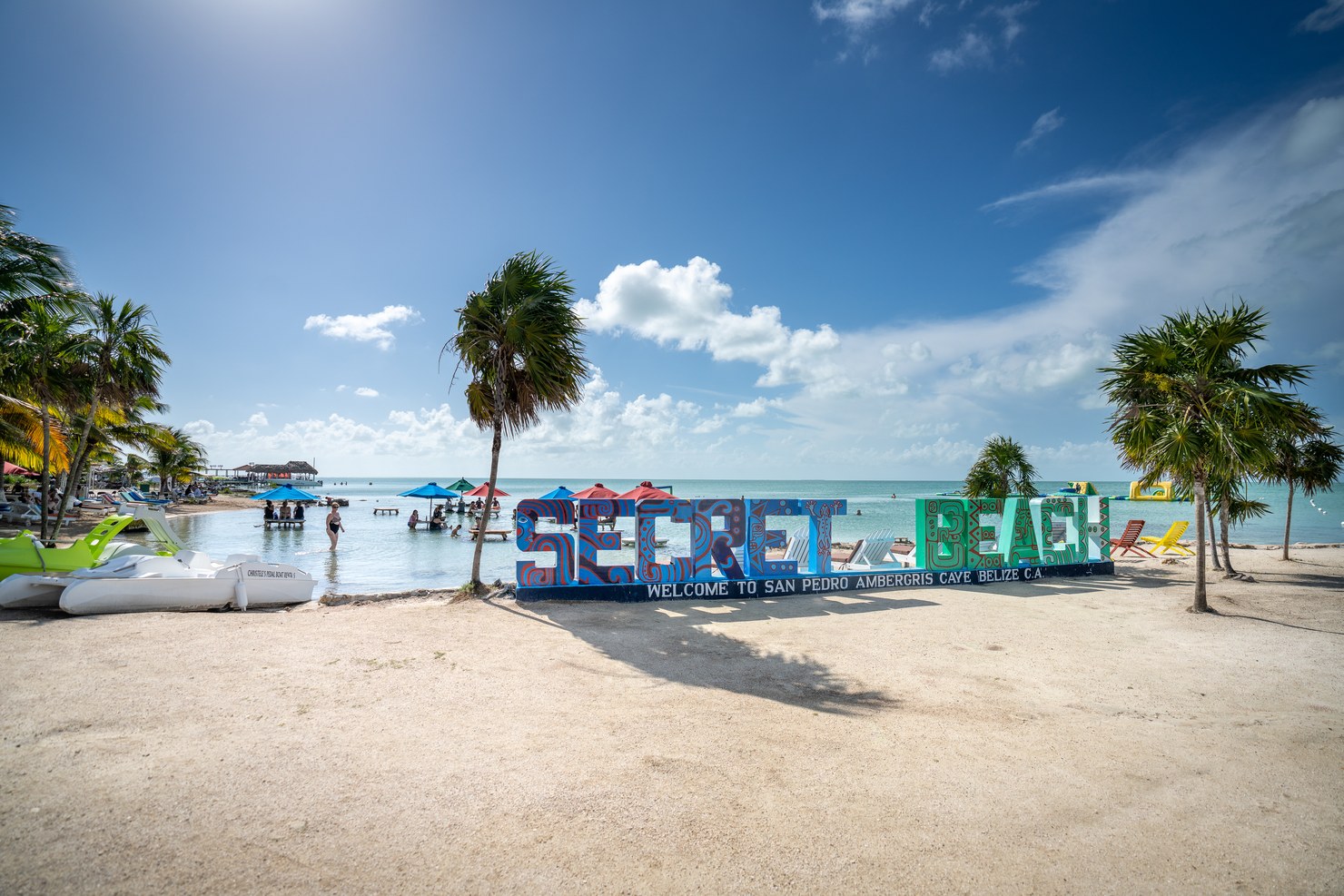 Secret Beach
 was named by someone with a sense of humor — on a Sunday it can feel like half of San Pedro got the same memo — but go on a weekday morning and the name earns itself back. The water is the story: waist-deep a long way out over a sandy bottom, warm, and clear in the way that makes people stand in it for hours doing nothing, happily. The setup is beach-bar civilization at its most relaxed: palapa tables in the shallows, bars and grills along the shore, kayaks and paddleboards for the restless. There is no entrance fee; your money goes to lunch and whatever is in the cooler. The cart ride out — thirty to forty-five minutes, the last stretch unpaved — filters the crowd better than any gate could. When dusk settles in, the mosquitoes arrive with a work ethic to rival the bartenders'.
The sunrise belongs to the east side. Secret Beach owns the other end of the day.

The reef, two ways
Everything on Ambergris Caye orbits the reef — but "the reef" is really two very different trips, and confusing them is the most common planning mistake visitors make.
Hol Chan & Shark Ray Alley: the snorkel story. Four miles southeast of San Pedro, a natural channel cuts through the barrier reef — Hol Chan, "little channel" in Mayan. The reserve around it, established July 1987 as Belize's first marine reserve, protects reef, seagrass, and mangroves. Inside the cut, the snorkeling is the Caribbean at full volume — coral gardens, turtles, rays, moray eels. Then the boat moves a few hundred yards to Shark Ray Alley, a shallow sand flat where nurse sharks and southern stingrays gather. The honest context: those animals are habituated — decades of guides cleaning catch there taught them boats mean food. Some travelers find the encounter thrilling; others find the conditioning uncomfortable. It is presented here as it is. New to snorkeling? Start at Mexico Rocks, a shallow patch reef off the island's north end — the gentle on-ramp. And one correction the internet keeps getting wrong: Hol Chan is not a UNESCO site. That designation belongs to the Blue Hole and Bacalar Chico, components of the Belize Barrier Reef Reserve System inscribed in 1996.
The Great Blue Hole: the dive story. At Lighthouse Reef Atoll, about forty-four miles offshore, a collapsed limestone cave system opens into a near-perfect circle roughly 1,000 feet across, plunging past 400 feet deep — famous since Jacques Cousteau declared it one of the world's great dive sites. Its submerged stalactites are the draw for experienced divers; they are not visible to snorkelers at the surface. If coral, fish and a lively shallow-water encounter are what you want, choose Hol Chan instead. The Blue Hole's appeal is geological, and its offshore setting makes the weather part of the decision.
The table: San Pedro after the boats come in
A working town feeds itself well. Start with the institutions. Elvi’s Kitchen has been feeding San Pedro since 1974 — the island's dining room in the best sense, Belizean classics in the middle of town. El Fogon cooks the traditional way, over an open wood fire — the name means "the stove," and the stewed and smoked dishes taste like it promises. The Belizean plate to order first, anywhere: rice and beans in coconut milk, stew chicken darkened with recado, potato salad on the side.
For a sunset with altitude, Rain Restaurant & Rooftop Terrace, on the rooftop at Grand Caribe two miles north of town, is the island's romantic occasion — reef on one side, the lagoon turning gold on the other.
Wash it down like a local: a cold Belikin, and something carrying Marie Sharp’s — the habanero sauce made in Belize since 1981, which has ended more "I can handle spicy" claims than the reef has ended sunburns.
Every island has one meal that becomes the reason you'd go back, and on Ambergris Caye ours is on a rooftop. Rain sits above Grand Caribe with the reef on one side and the lagoon turning gold on the other, and when the sun starts to go, there is nowhere else on the island we'd rather be sitting. Order the short ribs: beef braised low and slow with Belikin — Belize's own lager — until it gives up completely, over sweet potato purée. It's rich, it's unhurried, and it's the plate we still talk about. Some dinners feed you. This one stamps the passport in your head.
A day on Caye Caulker: go slow
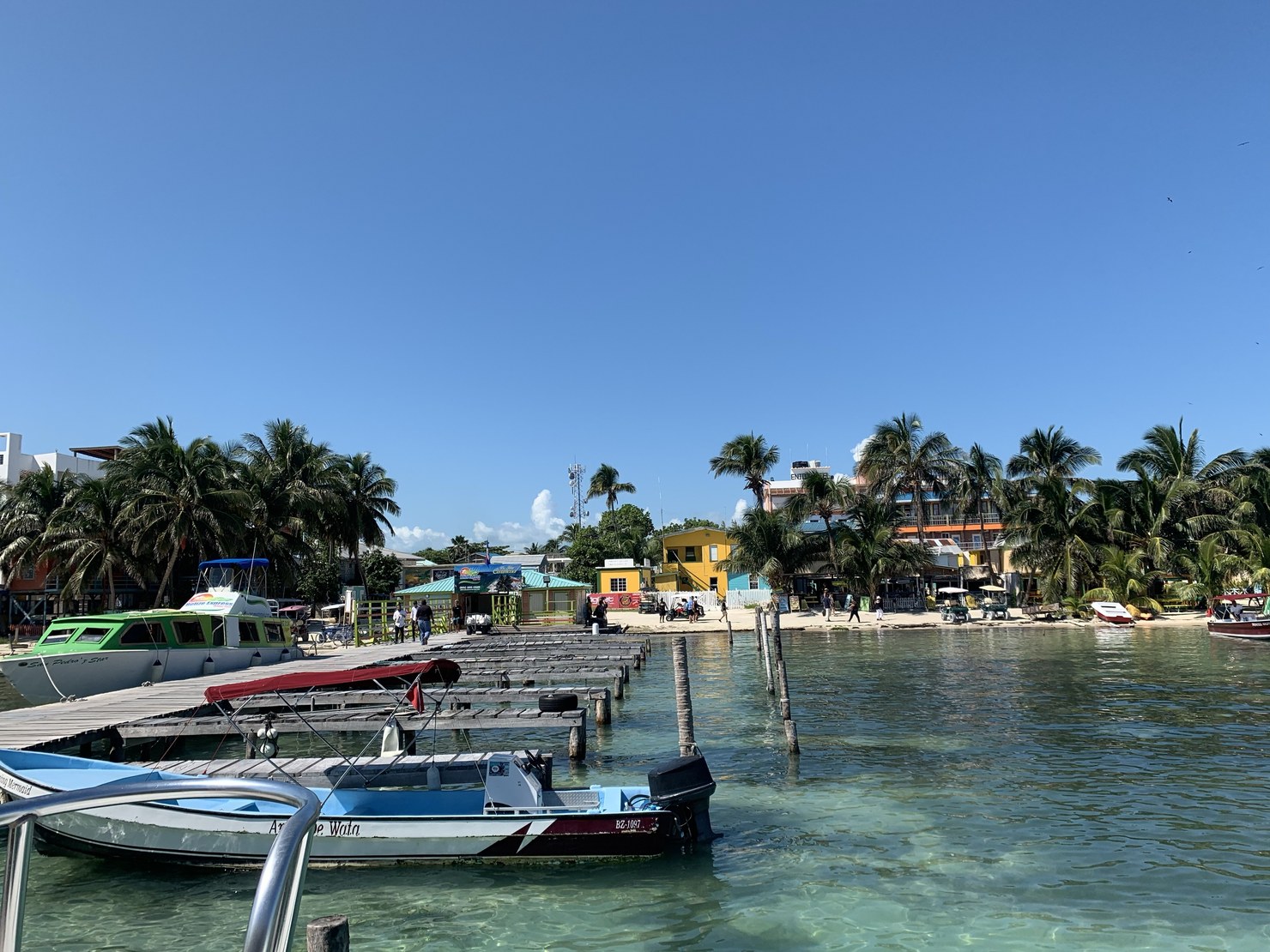
Twenty-five to thirty minutes by water taxi from San Pedro sits Ambergris's little sister — five miles long, almost no cars, and a motto the whole island obeys: Go Slow. There's time here to do it properly.
 Caye Caulker
The Split, the channel dividing Caye Caulker, is popularly credited to Hurricane Hattie's storm surge in 1961 — though islanders and more careful local histories describe it as finished, if not started, by hand, dredged wider by residents in the years after the storm rather than cut by the hurricane alone. Either telling, it's now among the island's best-known sights, its swimming area and waterfront gathering spots drawing the whole afternoon crowd. Around dusk, guides hand-feed the tarpon that gather off the docks: a small, strange, wonderful ritual; ask any captain where tonight's feeding is.
The shape that works is the island's own: Go Slow — a boat over, a swim at the Split, lunch by the water, and an afternoon doing very little at a professional standard. The honest footnote: a day shows you Caulker's charm, not its depth. If it hooks you — it hooks a lot of people — it deserves two to four nights of its own on the next trip.
Who should skip Ambergris Caye
Directly, because fit guidance only helps when it is honest: skip it if you need a broad, swimmable, walk-in ocean beach — the reef geometry says no. Skip it if your vacation requires a rental car and highway freedom, if nightlife should run to 4 a.m. in clubs, or if a five-hour weather delay would ruin your trip; island logistics shrug at schedules. Everyone else: the reef is a half-mile out, the cart is gassed, and the sunset side is waiting.
Thinking about a week on Ambergris Caye? Paradox Travel Network can help you plan the trip.
Postcards from Paradox is published by Paradox Travel Network.